Washington State’s DOH offers programs to help prevent
illness and injury and promote healthy places to live and work
The Washington State Department of Health (DOH) protects and
improves the health of people In Washington State. Its programs help
to prevent illness and injury, promote healthy places to live and
work, help people to make good health decisions, and ensure that the
state is prepared for emergencies. The department administers a budget
of $1.2 billion, 66% of which is invested in the community through
other organizations.
Areas that the department is active in include drinking water, food
safety and radiation protection, rural health, public health
laboratories, communicable disease control, health professional
credentialing, emergency preparedness and response, and women,
infants, and children nutrition.
To better serve customers, the DOH wanted to make IT easy to use,
transparent, and cost-effective
All of these areas depend
on IT. The department’s IT team is committed to providing responsive
support for its customers, delivering the services that other teams
need to execute the department’s mission effectively. That’s why the
IT team launched a far-reaching transformation program, moving to what
it refers to as an IT-as-a-Service model.
According to Amy Wilson, DOH’s enterprise system support supervisor,
“We wanted to run IT as a business, creating products and services
that are tailored to meet our customers’ needs. With IT-as-a-Service,
customers choose services from a catalog of service offerings and only
pay for what they use. Our goal is to make IT easy to use,
transparent, and cost-effective–strengthening the department’s efforts
to serve the people of Washington State.”
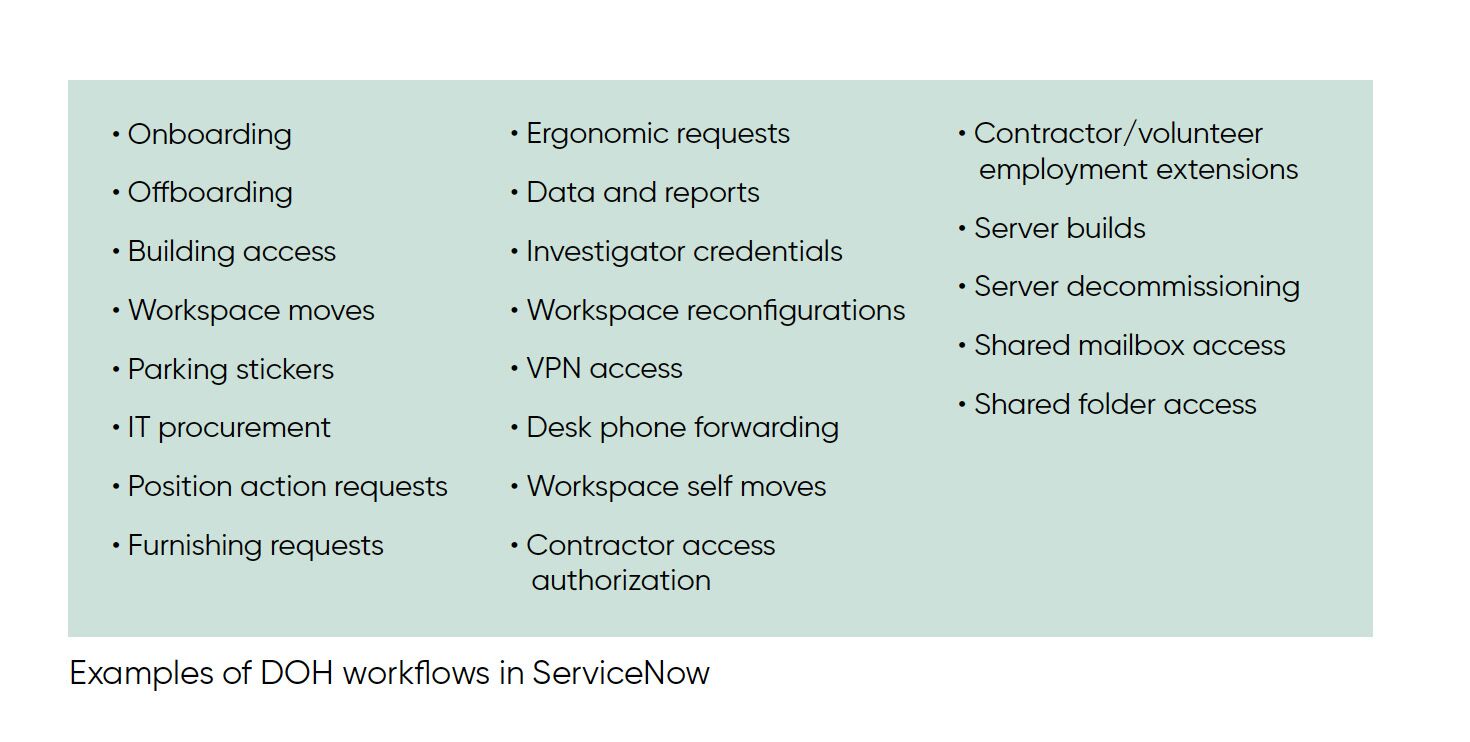
With ServiceNow, the DOH adopts IT-as-a-Service and retires
multiple systems from more than 20 different programs and
services
However, DOH faced a major challenge. While it
was committed to IT-as-a- Service, it didn’t have the service delivery
platform it needed to succeed. Amy says, “We were struggling with
multiple ticketing systems. In some cases, we didn’t have a ticketing
system at all—just an email inbox for requests. There wasn’t one place
to go for IT services, and our customers were dissatisfied because
these systems were so cumbersome to use. And, because everything was
disconnected, we couldn’t provide cost transparency, and we didn’t
have the end-to-end visibility we needed to drive continual service improvement.”
To lay the foundation for success, DOH decided to partner with
ServiceNow. The department went live with an initial ServiceNow IT
Service Management solution that included Incident, Asset,
Configuration, Change, Request and Knowledge Management—allowing it to
retire various request systems used in more than 20 different programs
and services.